
Case study: From Network Rail to Capital Loop, how Coinstancy is exploring Avalanche for stablecoin savings liquidity

The strongest blockchain integrations should not stop when funds arrive. They begin with access, develop through product activity, and become strategically more valuable when liquidity can remain useful within the ecosystem supporting that product.
This is the opportunity Coinstancy is exploring with Avalanche.
For many crypto products, integrating a new network primarily means enabling deposits and withdrawals. Users can move funds into the application, withdraw them when needed, and benefit from another route to access the product. From the network's perspective, the integration generates transactions and stablecoin flows.
This model is useful, but its role often remains limited to capital movement.
Coinstancy wants to explore a deeper model with Avalanche. The objective is not only to allow users to enter and exit Coinstancy through the network, but to assess whether eligible liquidity connected to the Savings product could also remain economically active within selected parts of the Avalanche ecosystem.
If the appropriate conditions are met, Avalanche could become more than a technical rail into Coinstancy. It could form part of the wider liquidity infrastructure supporting the Savings product.
Users could enter through Avalanche and access a simple savings experience managed by Coinstancy. Behind the product, Coinstancy would continue to assess, route, and monitor eligible liquidity according to its internal risk and allocation framework. Where Avalanche-native opportunities meet Coinstancy's requirements for protocol quality, liquidity depth, technical risk, monitoring, and coverage, part of that liquidity could potentially be deployed within the ecosystem.
For users, the experience remains simple. For Coinstancy, Avalanche becomes part of the operational path supporting Savings. For Avalanche, the opportunity extends beyond deposits and withdrawals to recurring transactions, stablecoin activity, active wallets, and potentially deeper liquidity within selected ecosystem venues.
This is the model Coinstancy and Avalanche are exploring together: a shift from network rail to capital loop.
A different way to think about blockchain integrations
A blockchain network can support several distinct functions within a financial product.
The first is access. Users need an efficient and reliable way to move funds into and out of an application. For a savings product, this is particularly important because the deposit experience is often the user's first interaction with the underlying infrastructure. Friction at this stage can make the entire product feel complex before the user has even started saving.
The second function is activity. Deposits, withdrawals, transfers, wallet interactions, and operational movements all create onchain usage. For the ecosystem, this activity demonstrates that the network is supporting a genuine financial use case rather than being used exclusively for speculative transactions.
The third function is allocation.
This is where the relationship between a network and a product can become significantly more strategic. If some of the liquidity connected to a product can also be deployed into carefully selected venues within the same ecosystem, the network is no longer limited to supporting the movement of capital. It begins to support part of the infrastructure behind the product itself.
Coinstancy wants to explore these three layers with Avalanche.
Avalanche can support access by providing a route into and out of Coinstancy. It can support recurring onchain activity generated by a savings product. Finally, if suitable opportunities are identified and approved through Coinstancy's internal framework, Avalanche could potentially support part of the allocation layer behind Coinstancy Savings.
Connecting access, activity, and allocation creates a stronger integration model than simply adding another supported network.
The Coinstancy model
Coinstancy is building a simple user-facing savings experience on top of complex onchain infrastructure.
Users should not need to manage wallets, compare protocols, assess liquidity venues, understand smart contract dependencies, or make allocation decisions themselves. They should be able to access a clear Savings product, follow their balance, and withdraw when needed.
Coinstancy manages the operational and infrastructure layers behind that experience.
This includes the Savings product itself, liquidity routing, protocol assessment, allocation decisions, ongoing monitoring, internal risk controls, and user support. Coinstancy's objective is to make stablecoin savings accessible to a broader audience while retaining the benefits and infrastructure available through decentralized finance.
The product is designed around a defined user-facing savings experience, with rates managed by Coinstancy, per-second interest accrual and compounding, and no user lock-up. Behind the product, Coinstancy can manage liquidity across multiple protocols and continuously monitor protocol conditions, liquidity, exposure, and relevant risk signals.
Coverage also forms an important part of Coinstancy's risk-management approach. Where applicable, exposures can be integrated into a coverage framework subject to the relevant policy terms, limits, exclusions, capacity, and defined covered events. Coverage is treated as an additional risk-control layer alongside due diligence and monitoring, rather than as a replacement for them.
For clarity, any rate displayed to users through Coinstancy Savings is defined, managed, and offered solely by Coinstancy. Avalanche acts as blockchain infrastructure and does not set, guarantee, endorse, or promise any APY, fixed yield, or user return offered by Coinstancy.
This separation is fundamental to the model. Avalanche can provide infrastructure, while Coinstancy remains responsible for the Savings product and the decisions related to its underlying liquidity strategy.
Any Avalanche-native deployment would therefore remain subject to Coinstancy's own review, internal standards, and operational decisions.
The partnership opportunity is not about associating Avalanche with a promised return. It is about exploring how Avalanche can support the infrastructure behind a real stablecoin savings use case.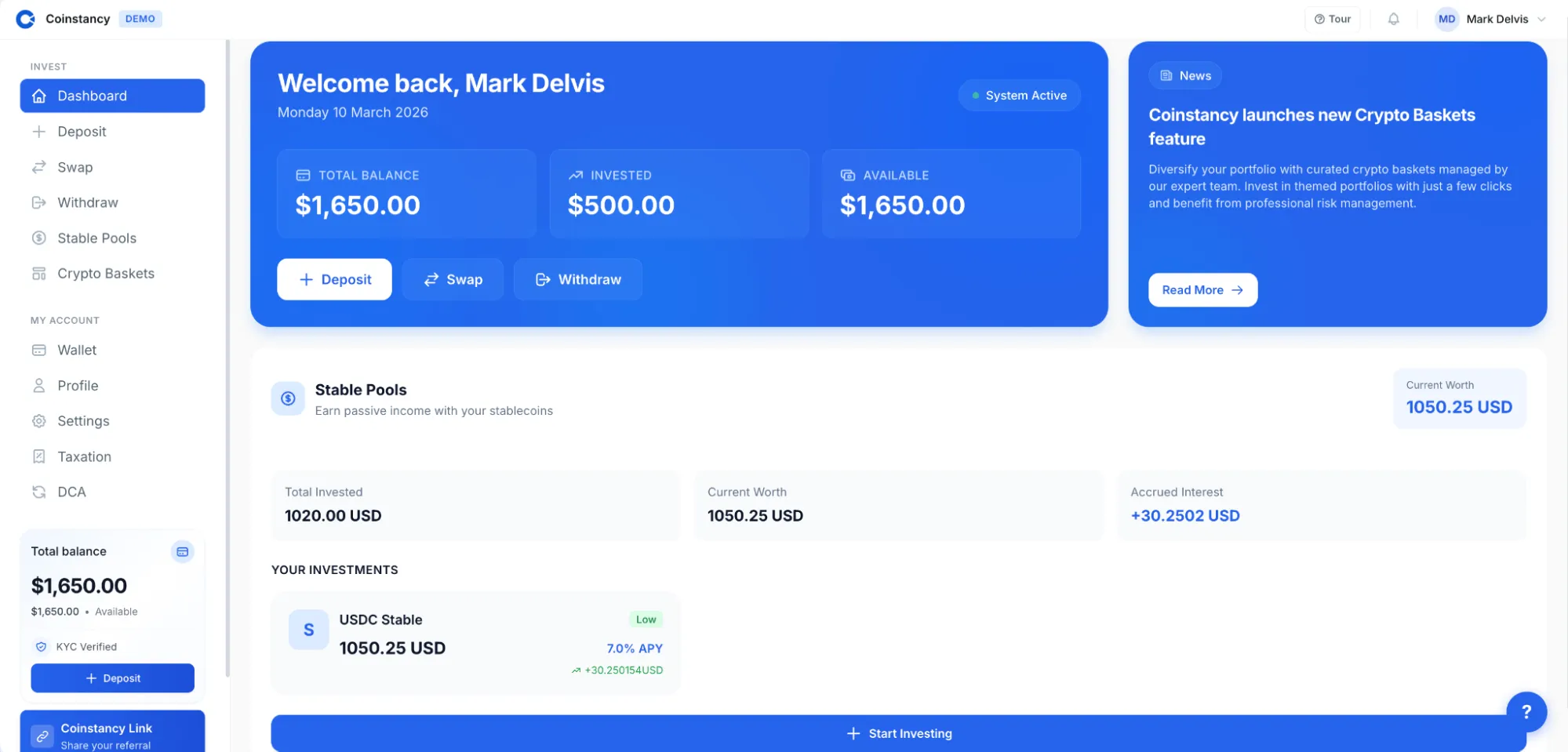
Why Avalanche
Stablecoin savings requires more than a network capable of moving assets efficiently. It requires an environment that can support regular capital flows, operational liquidity, and access to onchain financial infrastructure.
For Coinstancy, the strategic interest in Avalanche lies in the possibility of connecting user access with deeper ecosystem activity.
At the user level, Avalanche can provide an efficient route into Coinstancy Savings. Users can deposit through a supported network, access the product, and withdraw when needed without having to manage the underlying complexity of onchain infrastructure themselves.
At the operational level, deposits, withdrawals, transfers, and liquidity movements can generate recurring stablecoin activity across the network.
The larger opportunity, however, is to assess whether eligible liquidity connected to Coinstancy Savings could also remain active within the Avalanche ecosystem.
If selected Avalanche-native venues meet Coinstancy's requirements, part of the underlying liquidity could potentially be allocated to suitable DeFi infrastructure within the ecosystem. This could include different types of onchain financial venues, such as decentralized liquidity infrastructure, automated strategy environments, or lending markets, provided that each opportunity successfully passes Coinstancy's due diligence and ongoing monitoring framework.
In this model, Avalanche would not simply be used at the edge of the Savings product. It could potentially become part of the liquidity path behind it.
For Avalanche, Coinstancy can bring a user-facing financial product capable of generating activity beyond speculative trading. Stablecoin savings can support recurring deposits, withdrawals, wallet activity, and operational transactions. Where eligible liquidity remains deployed within selected Avalanche venues, the product may also contribute to deeper ecosystem liquidity and TVL.
This is what makes the opportunity strategically stronger than a standard network integration.
The Capital Loop
The Coinstancy and Avalanche opportunity can be understood through a capital loop connecting user access, savings infrastructure, liquidity assessment, potential ecosystem deployment, monitoring, and exit.
The first stage is entry.
A user deposits stablecoins through Avalanche and accesses Coinstancy Savings. Avalanche provides the infrastructure supporting the user's route into the product and the corresponding onchain activity.
Once Savings is activated, Coinstancy manages the routing of eligible liquidity according to its internal framework. The user does not manually select protocols or decide where capital should be deployed. Coinstancy manages the operational process behind the product.
The next stage is assessment.
Coinstancy reviews whether part of the underlying liquidity may be allocated to opportunities available within the Avalanche ecosystem. This review considers the maturity and operating history of each venue, smart contract architecture, audits, governance, technical dependencies, liquidity depth, market structure, monitoring capabilities, and overall risk profile.
Coverage availability and the conditions attached to any relevant coverage mechanism are also reviewed.
The existence of an attractive yield is not sufficient to justify an allocation. An opportunity must also be compatible with the liquidity requirements, operational standards, and risk objectives of Coinstancy Savings.
Only when these conditions are met can deployment be considered.
If selected Avalanche-based opportunities satisfy Coinstancy's requirements, part of the eligible liquidity could potentially be allocated within the ecosystem. The objective is not to maximize yield at any cost, but to identify infrastructure capable of supporting a stable, understandable, and risk-managed Savings experience.
The capital loop continues after deployment through ongoing monitoring.
Coinstancy reviews exposure, available liquidity, performance, protocol risk signals, technical conditions, dependencies, and broader market developments. The allocation framework is not based on a one-time due diligence process. Strategies must remain observable and manageable throughout the lifecycle of the position, and allocation decisions may evolve when conditions change.
The final stage is exit.
When users withdraw from Savings, Coinstancy manages the underlying liquidity requirements and the operational process necessary to support the withdrawal. Avalanche can again support the movement of funds out of the product, completing the loop between user entry, Savings infrastructure, potential ecosystem allocation, and exit.
This is the fundamental difference between a rail and a capital loop.
A rail moves funds between two points. A capital loop connects access to recurring product usage, liquidity allocation, continuous monitoring, and user withdrawals.
“At Coinstancy, we do not want blockchain integrations to stop at deposits and withdrawals. With Avalanche, the stronger opportunity is to explore whether eligible liquidity entering through the network can also support vetted opportunities inside the ecosystem. If the right protocols, liquidity depth, risk profile, and coverage options are available, Avalanche can become part of the capital loop behind a simple, covered stablecoin savings experience.” Armand Bouchard, CEO of Coinstancy
What needs to be true before Avalanche-native deployment
An Avalanche-native allocation strategy would need to be built carefully.
Coinstancy would not deploy liquidity into a venue simply because it operates within the Avalanche ecosystem or offers an attractive return. Every potential opportunity must be compatible with the internal standards applied to the Savings product.
Protocol quality is the first requirement.
Coinstancy assesses protocol maturity, operating history, smart contract structure, security audits, governance mechanisms, administrative controls, technical dependencies, oracle exposure, and known risk factors. The objective is to understand not only the protocol itself, but also the external infrastructure and dependencies capable of affecting an allocation.
Liquidity depth is equally important.
A savings product needs reliable entry and exit conditions. Coinstancy must be able to manage operational movements and user withdrawals without creating excessive slippage, liquidity stress, or unnecessary friction. A strategy may offer attractive economics while remaining unsuitable for a Savings product if available liquidity is insufficient or inconsistent.
Risk coverage is another important component of the framework.
Coinstancy's model integrates coverage where appropriate and available. An Avalanche-native opportunity is therefore stronger when relevant risks can be covered through a suitable coverage provider. Any such mechanism remains subject to policy conditions, limits, exclusions, capacity, and defined covered events.
Coverage does not eliminate protocol risk and does not replace due diligence. It provides an additional layer within a broader framework combining protocol selection, diversification, monitoring, and operational controls.
Continuous monitoring is also essential.
Coinstancy needs to remain capable of observing performance, liquidity, exposure, technical risk, and market conditions after deployment. A venue that cannot be effectively monitored does not fit the operating requirements of the Savings infrastructure.
Finally, every opportunity must remain aligned with the product itself.
Coinstancy is not designed to chase every available source of yield. The underlying strategy must support a simple and consistent savings experience for users. Infrastructure complexity can remain behind the product, but it must be manageable, observable, and compatible with Coinstancy's risk objectives.
These conditions are what distinguish an ecosystem campaign from a genuine financial infrastructure strategy.
Why the Capital Loop matters for Avalanche
For blockchain ecosystems, the next stage of adoption is not simply about increasing the number of applications that support a network.
The deeper opportunity is to attract financial products capable of generating durable and recurring activity.
A network can appear across many applications without becoming central to the products themselves. If users deposit through the network and the underlying capital immediately moves elsewhere, the ecosystem primarily serves as a transport layer.
Stablecoin savings creates the possibility of a different type of activity.
Users may make recurring deposits and remain active within a savings product for extended periods. Deposits, withdrawals, and operational liquidity movements can generate continuous onchain activity rather than isolated transactions.
If Avalanche-native opportunities also meet Coinstancy's allocation standards, part of the underlying liquidity could potentially remain active within the ecosystem rather than simply passing through it.
This creates alignment between Coinstancy and Avalanche.
Coinstancy wants to provide a simple, risk-managed, and covered savings experience while retaining access to onchain financial infrastructure. Avalanche wants to support real onchain use cases, useful financial products, and deeper ecosystem activity.
The capital loop connects these objectives.
For Avalanche, the value of Coinstancy is therefore not limited to another application adding network support. The larger opportunity is to support a user-facing Savings product capable of connecting capital inflows to recurring transactions and potentially to ecosystem-native liquidity.
Why this matters for users
Users do not need to see every layer of the capital loop.
That is one of the main objectives of Coinstancy.
A user should not need to choose between lending markets, decentralized liquidity venues, or automated strategies. They should not need to read smart contracts, compare protocol audits, monitor liquidity conditions, or follow each underlying allocation individually.
The user accesses Coinstancy Savings, follows their balance, and withdraws when needed.
Behind the scenes, Coinstancy evaluates and manages the infrastructure supporting the product.
If eligible Avalanche-native opportunities meet Coinstancy's internal requirements, part of the underlying liquidity could potentially be routed into selected venues within the ecosystem. Coinstancy remains responsible for assessing the opportunities, making allocation decisions, monitoring exposures, and adapting the strategy when conditions evolve.
The complexity remains abstracted from the user.
This is how onchain finance becomes easier to access.
Mainstream adoption does not require every user to become a DeFi analyst. It requires product layers capable of managing technical and financial complexity while presenting a clear and understandable experience.
Coinstancy is building that product layer for savings.
Avalanche can potentially support part of the infrastructure behind it.
A stronger partnership model
The Coinstancy and Avalanche opportunity also illustrates what a deeper blockchain partnership can look like.
A basic integration adds a network option to a product. A stronger partnership considers how the product and the ecosystem can create a recurring financial loop together.
Avalanche can support user access through deposits and withdrawals and generate network activity through recurring onchain transactions. If suitable Avalanche-native venues meet Coinstancy's standards, the ecosystem could also potentially support part of the liquidity infrastructure behind Savings.
Coinstancy brings the user-facing product, the operational framework, the allocation process, and the internal risk discipline necessary to manage this infrastructure within a single savings experience.
The roles remain clearly separated.
Avalanche provides blockchain infrastructure. Coinstancy manages Savings and the underlying allocation framework. Selected Avalanche-native venues may provide eligible deployment opportunities when they satisfy Coinstancy's requirements.
The result is a partnership model built around a real product use case rather than a simple network announcement.
Avalanche is not positioned as a passive network integration. It becomes a potential environment for stablecoin savings liquidity.
Coinstancy is not simply adding another chain. It is exploring whether user inflows and underlying Savings infrastructure can create deeper activity within the Avalanche ecosystem.
“Coinstancy represents the kind of user-facing product that can bring meaningful financial activity onchain. By exploring Avalanche not only as an access network, but also as a potential environment for stablecoin savings liquidity, Coinstancy shows how blockchain infrastructure can support real product usage and deeper ecosystem activity.” Avalanche team
Avalanche as part of the savings value chain
The long-term opportunity is to connect four elements that are often treated separately: user access, stablecoin savings, DeFi liquidity, and ecosystem growth.
Avalanche can help connect these layers.
Users can enter Coinstancy through Avalanche and access the Savings product. Coinstancy can manage the user experience, underlying liquidity strategy, protocol assessment, and ongoing monitoring. Where suitable opportunities are identified, eligible liquidity can potentially remain active within selected Avalanche-native infrastructure.
Avalanche can benefit from deposits, withdrawals, transaction activity, stablecoin flows, active wallets, and potentially deeper TVL within the ecosystem.
Coinstancy benefits from access to an additional environment in which eligible Savings liquidity may be deployed under clearly defined conditions.
Users continue to interact with a simple savings experience without managing the complexity behind the product.
This turns Avalanche from a transaction rail into a potential part of the savings value chain.
The core message is therefore not simply that Coinstancy supports Avalanche.
Coinstancy is exploring how Avalanche can become part of the full stablecoin savings loop, from user inflows to potential native liquidity deployment and ultimately to user withdrawals.
Beyond the rail
The opportunity between Coinstancy and Avalanche is not limited to adding another supported network.
It is about exploring a more complete model for blockchain-powered savings.
Avalanche can support the route users take into and out of Coinstancy. It can generate recurring activity around deposits, withdrawals, and operational movements. Where selected Avalanche-native venues satisfy Coinstancy's standards, the ecosystem can potentially host part of the liquidity infrastructure behind Savings.
Coinstancy can combine these layers within a product designed to remain simple for the end user.
This is how a network integration becomes more than a rail.
It becomes a capital loop connecting users, a Savings product, underlying liquidity infrastructure, continuous monitoring, and ecosystem activity.
That is the direction Coinstancy and Avalanche are exploring together.
From network rail to capital loop.